What are the rules of I'tikaf?
Question · One of the most asked questions about Ramadan
I've taken time off work to do I'tikaf for the last ten days of Ramadan for the first time. What are the main rules I need to follow, and when am I allowed to leave the mosque?
Short answer
In I'tikaf you stay in a mosque with the intention of worship, leave only for real needs and avoid intimate relations. For the last ten nights, enter before sunset on the 20th day.
Detailed answer
The basic rules of I'tikaf are simple: make the intention, stay in a mosque, leave only for genuine needs, and avoid what breaks it, especially intimate relations. The rest of the time is spent in worship.
What the Quran and Sunnah say
Allah says: "Do not have relations with your wives while you are in i'tikaf in the mosques" (Al-Baqarah 2:187). This shows both that I'tikaf takes place in mosques and that intimacy is not allowed during it. Aisha described the Sunnah for the person in I'tikaf as not leaving the mosque except for an unavoidable need (Abu Dawud).
Main conditions
- Intention: to stay in the mosque for the sake of Allah.
- A mosque: preferably one where the five prayers are held in congregation, and ideally where Friday prayer is held, so you do not have to leave for it.
- Purity: a person who needs ghusl, or a woman on her period, does not stay in the mosque for I'tikaf.
When can I leave?
- To use the toilet, make wudu or take a ritual bath (ghusl).
- To fetch food if nobody can bring it to you.
- For Friday prayer, if your mosque does not hold it.
- For a real emergency, such as a medical need.
Leaving without need, for example going home to relax or going shopping, breaks the I'tikaf.
Timing for the last ten days
To cover all ten nights, most scholars say you should enter the mosque before sunset on the 20th day of Ramadan and stay until the end of the month is announced. In 2027 this is expected to be before sunset on Saturday 27 February. Some scholars also require fasting for I'tikaf; this is not an issue in Ramadan, when you are fasting anyway.
Tips
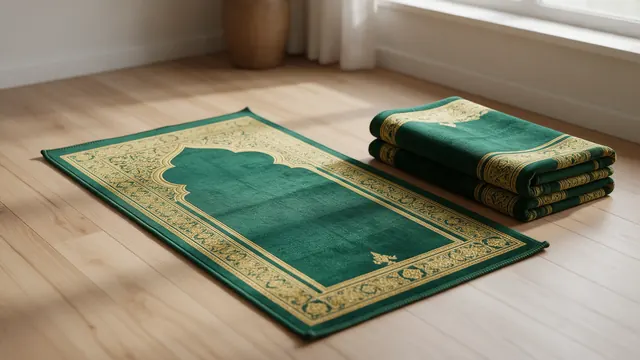
- Bring a sleeping mat, simple clothes, toiletries and a Quran.
- Keep your phone for emergencies only.
- Respect the mosque: keep your space tidy and talk quietly.
See also intimacy during I'tikaf, what I'tikaf is and a short I'tikaf of a few hours.
These answers give the general ruling based on the Quran, the Sunnah and the mainstream view of scholars. For a personal situation, ask a qualified scholar you trust.
Ask your question
Could not find your question? Send it to us. We add answers to the most asked questions on this page.